One Farm. Five Herds.
Zero Waste.
The Hoot Integrated Farms LTD — a long-term, 50-acre integrated agribusiness enterprise combining goat, cattle, sheep, poultry and fishery production with a zero-waste circular economy and a halal-certified export strategy reaching the Middle East, UK and EU.
Zero-waste loop unlocked
30–45% feed & fertiliser savings
Phase-1 goal
Commission 3 production units
Zero-waste loop unlocked
30–45% feed & fertiliser savings
Phase-1 goal
Commission 3 production units
- 50acres
- 5units
- ₦184MYr 5
- 24–30months
- 35–50jobs
A retirement enterprise engineered like an ecosystem
Five complementary animal husbandry units — anchored by goat rearing for priority export — supported by a feed crop division, a processing and cold-storage plant, and a biogas infrastructure that converts every waste stream into a productive farm input.
Total Land Required
50 Acres
20.2 Ha — expandable to 100 acres
Total Setup Investment
₦180M–₦250M
Phased over 3 years
Annual Revenue (Year 3)
₦100M
Year 3 proposal projection
Break-Even Point
24–30 Months
After full operations
Primary Export Product
Live & Processed Goat
Middle East, EU, UK
Cost Reduction (Waste Cycle)
30–45%
On feed & fertiliser, Year 2+
Full Employment Capacity
35–50 Direct Jobs
Plus indirect supply chain
Strategic Location
Northern Nigeria
- · Kano airport & dry port within reach
- · Trade corridor to Niger, Chad & Sahel
- · Low land cost, flat arable terrain
The circular advantage
A key competitive advantage of this farm is the zero-waste circular production model. Poultry droppings are channelled into the fish ponds as a high-nitrogen feed supplement. Goat and cattle manure is directed into the biogas digester and composted as organic fertiliser across the crop and fodder fields. This vertical integration reduces feed and fertiliser purchases by an estimated 30–45% annually — the engine that makes the farm self-sustaining from Year 2 onwards.
Goats sit at the centre of the export strategy. The global halal meat market exceeds $200 billion annually, and Red Sokoto goats cost significantly less to produce in Northern Nigeria than Australian or New Zealand chevon — the current dominant formal suppliers — creating a durable price-competitiveness window once certification and cold-chain standards are met.
Built for the Northern climate
The long dry season (October–April) is a livestock health advantage — but every structure is engineered for 45°C heat, harmattan dust and a 7-month zero-rainfall window.
Dry Season Advantage
October–April dryness lowers tick burdens, fungal infections and foot-rot versus humid southern conditions.
Heat Engineering
38–45°C peaks demand 3.5 m eaves, ridge venting, whitewashed cavity walls, 30 cm roof overhangs and evaporative poultry cooling.
Water Security
200,000 L overhead tanks + 500,000–1,000,000 L underground reservoir secure a 7-month zero-rainfall window.
Harmattan Defence
Neem and Acacia windbreaks shield poultry lungs, ponds and solar panels from Nov–Feb dust winds.
Fifty acres, zoned like a working organism
One rectangle of Sudan Savanna farmland — road frontage for export logistics, fadama-adjacent water for the ponds — divided into nine production and infrastructure zones. Hover the allocation bar to explore each zone.
Farm Master Layout — 50 Acres
Northern Nigeria · top-down architectural plan
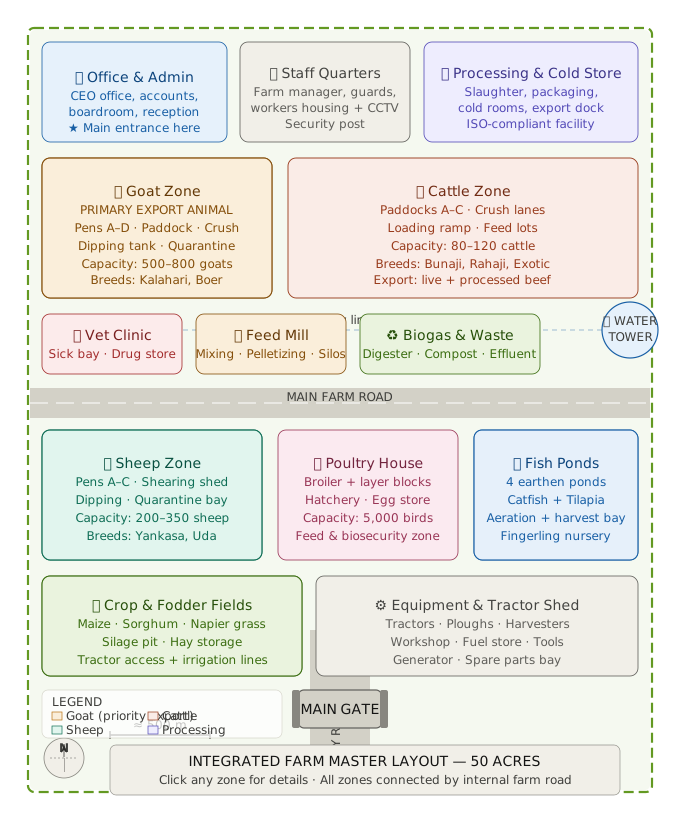
600–800 sqm admin block
CEO & manager offices, 16-seat boardroom, finance wing
200,000 L overhead storage
Gravity-fed distribution across all zones
Up to 1M L underground reservoir
Rainy-season capture for 7-month dry season
24/7 gatehouse + CCTV
Staffed security covering all farm zones
Land zone allocation
50 acres total · expandable to 100 acres in Phase 2
Siting note: an ideal plot has road frontage on at least one side for livestock trucks, near a river, dam or fadama. Target states — Kano (export logistics), Kaduna (midpoint connectivity), Sokoto/Kebbi (livestock tradition). Fadama land near the Kano River, Tiga Dam or Hadejia–Jama'are system is strongly recommended for the fish-pond component.
Five enterprise units, one biology of profit
Each unit is designed for Northern Nigeria's heat, dust and dry-season realities — from evaporative-cooled broiler houses to 1.8 m-deep seepage-proof fish ponds. Select a unit to inspect its design, breeds and revenue model.
Goat Zone
Flagship Export
The flagship export enterprise. Northern Nigeria is home to some of the finest goat breeds in Africa — the Red Sokoto (Maradi) is internationally recognised for leather and meat quality, and chevon commands strong demand across the Middle East, UK and EU.
- Total Area
- 8 acres
- Pens
- A–D · 100–200 goats each
- Opening Stock
- 200 → 600–800 (Yr 3)
- Export Price
- ₦80,000 → ₦120,000+
- Annual Off-take
- 80–100 → 250–400
- Est. Annual Revenue
- ₦8–12M → ₦30–48M
Recommended breeds
Red Sokoto (Maradi)
THE premier northern breed — prized 'Sokoto Red' leather exported globally for 500+ years
Sahel Goat (Bornu White)
Desert-adapted, heat-tolerant — preferred for live Middle East export
Kalahari Red Cross
Fast-growing, high meat yield via hybrid vigour with Red Sokoto
Boer Goat Cross
Premium export carcass breed, crossed locally for heat adaptation
Zone design & operations
Elevated slatted floors to combat heat and reduce hoof disease
Crush & loading lane for veterinary inspection, NAQS tagging and export containers
Dipping tank for tick control — critical post-rainy season
30-day quarantine bay isolated from trade-route disease entry
Acacia & neem shade trees inside rotational grazing paddocks
Revenue · Year 1
₦8M–₦12M
Revenue · Year 3
₦30M–₦48M
UAE, Saudi Arabia, UK — halal-certified premium FOB pricing
The 12-acre feed engine
Crop & fodder fields are the backbone of feed-cost reduction — irrigated through the 7-month dry season, fertilised by the farm's own compost and digestate.
Napier Grass
4 ac
Year-round (irrigated)
Fresh cut fodder, ensiled · feeds Cattle, goats, sheep
Sorghum (Guineacorn)
3 ac
Rainy (Jun–Oct)
Grain for poultry + fish feed · feeds All species
Maize
2 ac
Rainy + dry (irrigated)
Grain pellets + cattle silage · feeds Poultry, fish, cattle
Cowpea + Groundnut
2 ac
Rainy season
Protein supplement, haulm fodder · feeds Goats, sheep, poultry
Moringa (Zogale)
1 ac
Year-round (irrigated)
25% crude protein supplement · feeds Goats, sheep
The vision — concept renders
Painterly concept art of each production unit at golden hour — illustrative visual direction for the build, not photographs of an existing site.
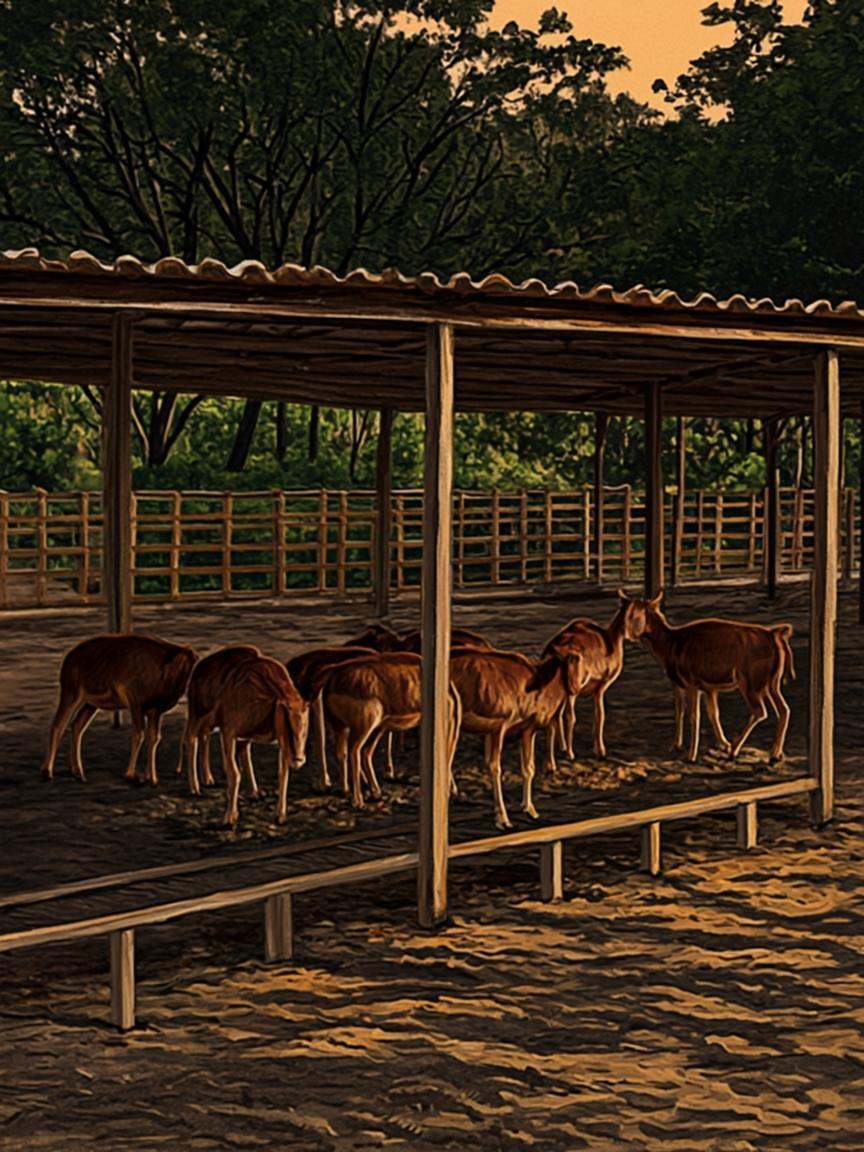
Goat Zone
Elevated slatted pens · Red Sokoto herd
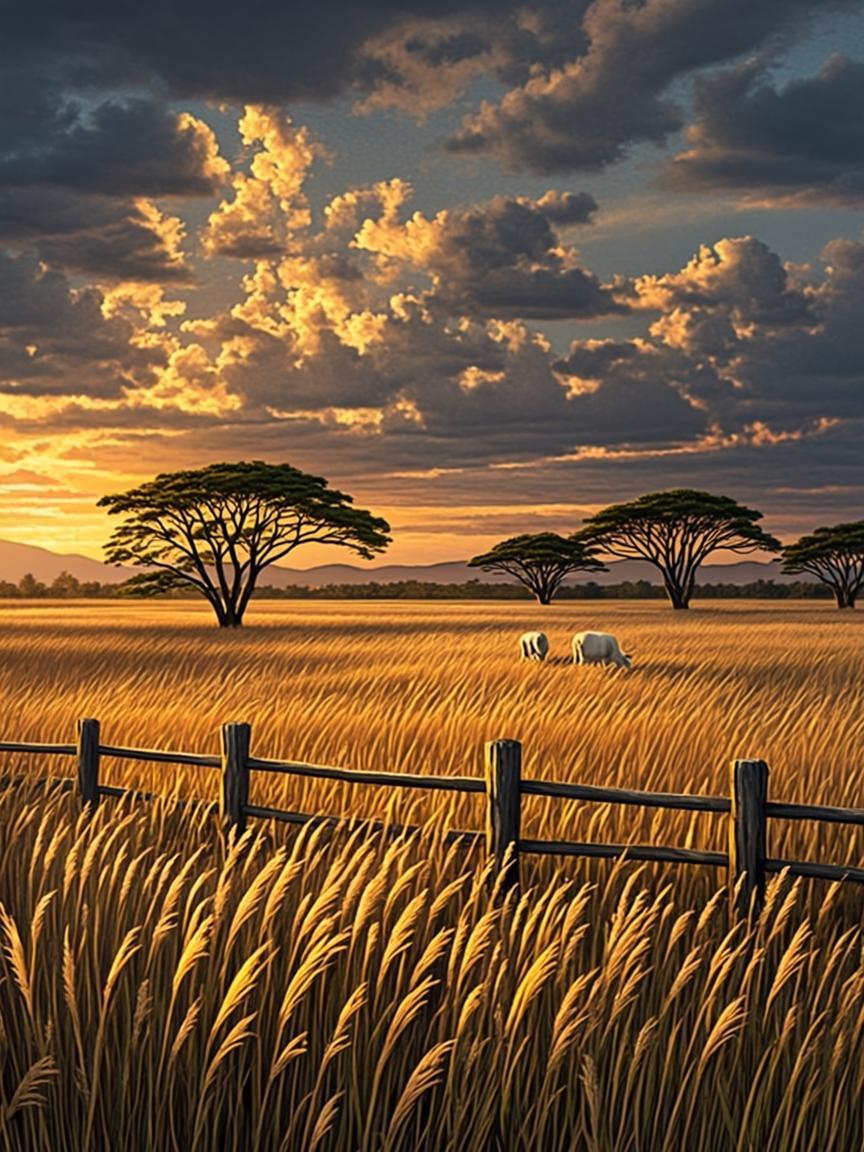
Cattle Zone
Rotational paddocks · Bunaji grazing
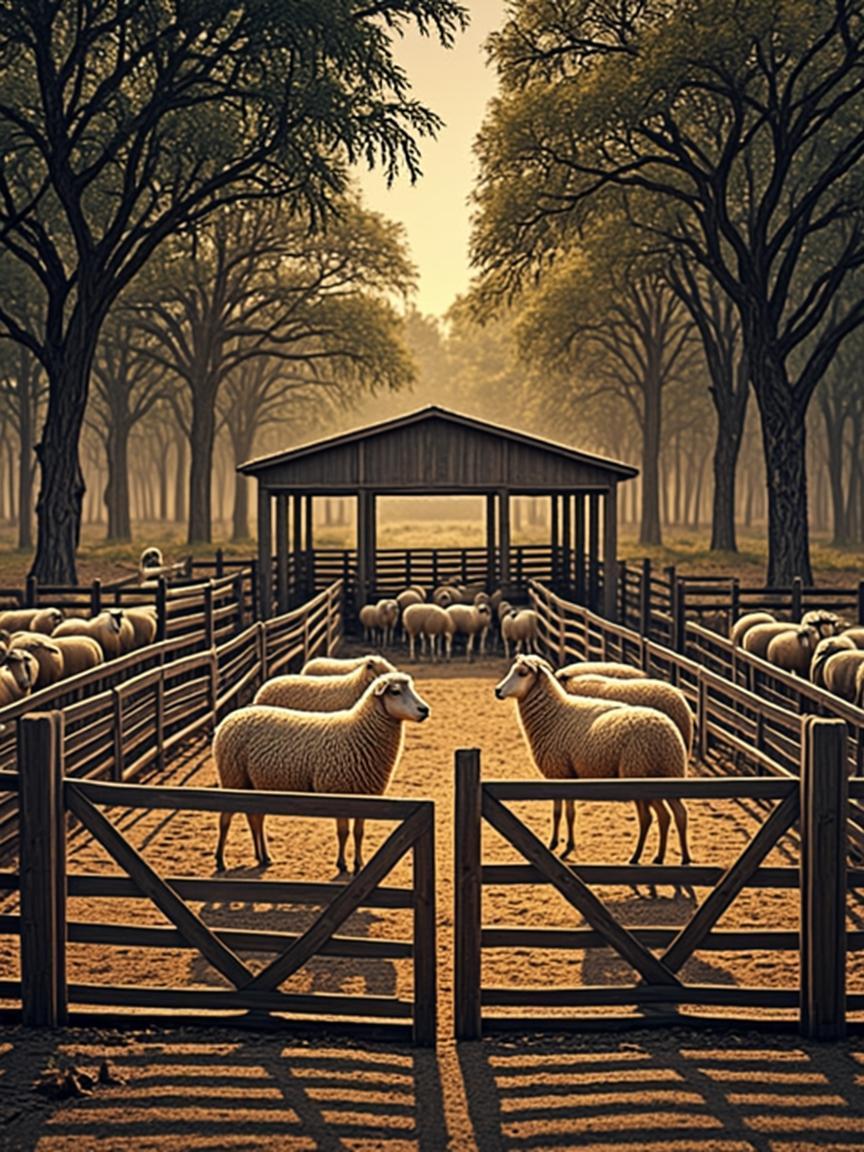
Sheep Zone
Yankasa stock · Eid festive peak
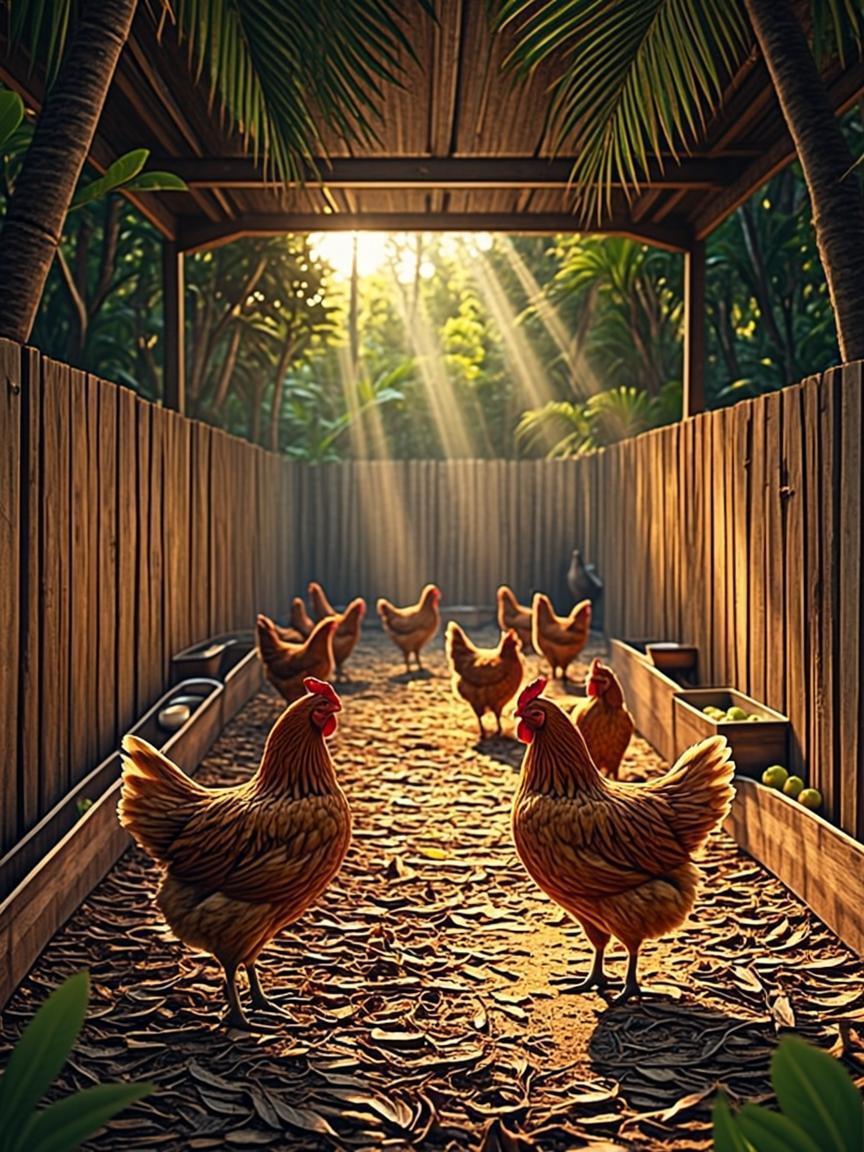
Poultry House
Deep-litter layers · cooling-pad climate
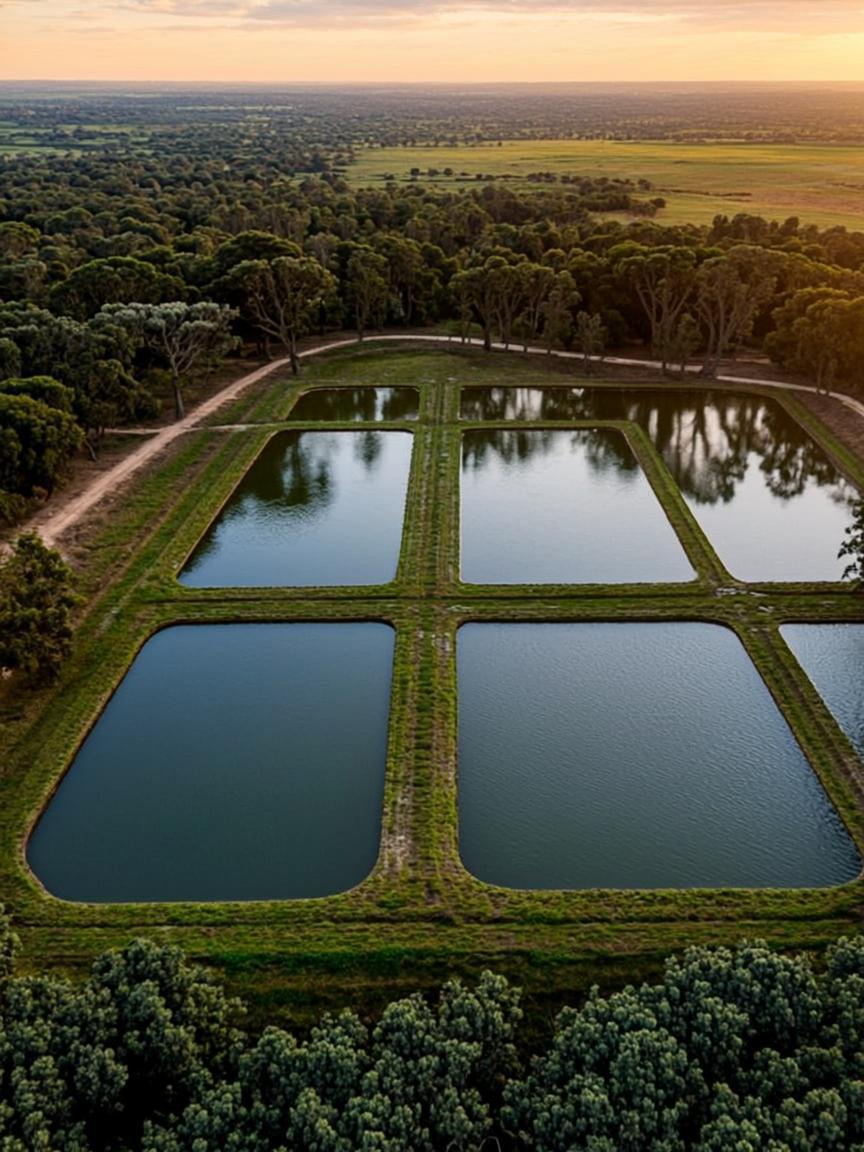
Fish Ponds
4 earthen ponds · waste-fed plankton
Swipe to explore all five units →
The circular economy: waste never leaves this farm
Rather than treating waste as a disposal problem, every stream becomes a productive input — feeding fish, fertilising crops, generating energy and improving soil. This is the engine that cuts operating costs by 30–45% from Year 2 onwards.
← Swipe to explore the full cycle diagram →
₦8M–₦15M
saved annually on feed & fertiliser from Year 2
30–50%
reduction in commercial fish feed cost
2–3 days
algal bloom response in warm northern water
₦1M–₦2M
yearly diesel displaced by biogas energy
Goat manure — “the gardener’s gold”: 2–3× richer in nitrogen than cattle manure, lower moisture, less crop burn. 60–70% goes to the fields at 5–10 t/ha/season — cutting NPK spend by ₦3M–₦6M a year.
Safety protocol: raw droppings are never applied directly to ponds — ammonia toxicity kills fish. Manure is composted 10–21 days first, applied on sunny mornings only, pond oxygen is monitored daily, and fertilisation pauses immediately if fish gasp at the surface.
Losses for a season, profits for a generation
Year 1 records a net loss as capital deploys and herds build. Year 2 returns to profitability as the circular waste cycles cut costs — by Year 3 the farm is fully profitable across all five units, compounding to ₦109M net by Year 5.
₦20M → ₦184M
Total revenue, Year 1 to Year 5
₦109M
Net profit by Year 5
24–30 mo
Break-even after full operations
≈₦216M
Total CAPEX over 36 months
Revenue by stream
Six income engines, ₦ millions per year
Revenue · costs · net result
The circular economy widens the margin from Year 2
Flagship stream — goats
From ₦8M in Year 1 to ₦75M by Year 5 as the herd grows from 200 to 600–800 head and export contracts deepen.
Leather by-product
Every Red Sokoto hide adds ₦5,000–₦15,000 — “Morocco leather” traded from Kano to Italy, Spain and the UK for over 500 years.
Festive upside
Eid al-Adha prices for Uda and Balami sheep rise 3–5× above normal market price — a recurring annual demand spike.
Investor scenario simulator
Choose a budget and scenario to explore the proposal assumptions
Revenue scenario
Presets set the assumptions below. Adjust them to explore your own case.
Illustrative baseline: 5% mortality. Operating costs comprise feed 45%, imported non-feed costs 20%, and other costs 35%. These shares require validation against farm quotations.
How the model works: your budget relative to the ₦216M build sets farm scale; revenue scales pro-rata while costs scale at a 0.8 exponent (smaller farms lose some efficiency). Year-5 enterprise value is estimated at 1.5× Year-5 revenue. This models farm scale, not equity ownership. Figures are unverified proposal assumptions, not promised returns.
Farm scale
100%
of the reference farm scale
Indicative value multiple · Yr 5
×2.40
profit + non-cash estimated enterprise value
Cumulative profit · Yr 5
₦242M
base scenario, modelled scale
Capital recovery
Month ~57
cumulative profit ≥ ticket
| Case | Five-year profit | Capital recovery |
|---|---|---|
| Downside | ₦70M | Beyond Year 5 |
| Base | ₦242M | Month ~57 |
| Upside | ₦369M | Month ~48 |
Preset assumptions are illustrative. The chart above reflects your current adjustments.
Modelled cash flow
Yearly net result vs cumulative profit, ₦ millions
Thirty-six months, three deliberate phases
A phased approach that manages capital outflow, lets early revenue fund later phases, and builds operational learning before full-scale expansion.
Phase 1
Foundation & First Livestock
Phase 2
Scale-Up & Processing
Phase 3
Full Operations & Expansion
Total capital expenditure: ≈₦216M over 36 months — within the ₦180M–₦250M total setup investment envelope.
Mechanisation & equipment
Phased acquisition — TOHOA tractor-hiring networks supplement owned fleet
From Kano to the world's halal dinner tables
Northern Nigeria sits at the crossroads of West African and trans-Saharan livestock trade. This farm formalises that flow — adding certification, cold chain and premium pricing to corridors that have carried Nigerian livestock for centuries.
$200B+
The global halal meat market — with goat meat among the most consumed proteins on earth. Nigerian production costs undercut Australian and New Zealand chevon, the current dominant formal suppliers.
- 500+ years of Red Sokoto leather trade from Kano
- Consistent UK, UAE & Saudi diaspora demand
- Emerging premium markets: Malaysia & Singapore
Four corridors out of the north
Route diversification is deliberate risk management — formal air/sea channels earn USD, while land corridors serve naira-denominated trans-Saharan demand.
Air Export
Kano — Mallam Aminu Kano Intl. Airport
Preferred for processed/frozen meat to Middle East & Europe. Existing cargo handling; cold-chain partners (Sifax, Skyway) operate in Kano.
Land Export — Niger
Illela / Jibia border crossings
Well-established live animal trade route — onward trans-Saharan trade to Libya, Algeria and North Africa.
Land Export — Chad
Maiduguri / Gamboru border
Active livestock corridor; Borno security situation factored into risk planning.
Sea Export
Lagos / Apapa Port (1,100 km by road)
Container shipments of frozen/processed meat to UK, EU & Asia — 18–24 hr refrigerated trucking from Kano.
Dry Port
Kano Inland Container Depot (ICD)
Customs clearance in Kano, then rail/road to Lagos; Kano–Lagos railway rehabilitation will cut transit time.
Export readiness checklist
These processes are long — the farm engages NAQS Kano, NAFDAC and a halal certification body in parallel with construction, not after it.
Halal Certification
NSCIA or internationally recognised body (e.g. HMC for UK)
NAQS Approval
Nigerian Agricultural Quarantine Service — mandatory for live animal & meat exports
NAFDAC Registration
For all processed and packaged meat products
Cold Chain Infrastructure
On-farm cold rooms + export-grade logistics partner
Phytosanitary Certificate
Federal Ministry of Agriculture — required by most importers
SON Standards
Nigerian Industrial Standards for export grading
Traceability System
Electronic ear-tagging + full birth-to-export farm records
Eyes open, herds protected
Northern operations carry real risks — and each one has a named owner, a funded mitigation and a protocol. No risk on this register is unmanaged.
Biosecurity backbone
Vaccination calendar with NVRI (Kaduna/Vom), a 30-day quarantine bay, full biosecurity separation of poultry from ruminant traffic, and a retained veterinarian — standard from Day 1.
Answers before the term sheet
The questions serious investors ask first — answered directly from the proposal's own numbers, plans and risk register.
Still curious?
Anything not covered here goes straight to the team — full investment, phase-level, export partnership and advisory enquiries are all welcome.
Ask the team directlyA compelling, well-structured enterprise
The combination of five complementary units, a zero-waste circular model and a halal export corridor creates a resilient, multi-revenue business that grows stronger as herds expand, cycles mature and export relationships deepen.
Five revenue engines, one land title
Goat, cattle, sheep, poultry and fish units spread exposure across different markets; correlated risks still affect the farm.
The circular moat
The proposal assumes waste-to-feed and waste-to-energy cycles could reduce selected operating costs by 30–45% — a structural advantage competitors must rebuild from scratch.
Export-grade from day one
Certifications, cold chain and traceability are sequenced into the build — first shipments leave by month 20–24.
A legacy asset
Herds appreciate, land appreciates, and the brand matures — designed as a prosperous, sustainable retirement enterprise.
Recommendation
Proceed with Phase 1 immediately upon land acquisition. Prioritise a site near a reliable water source; engage NAQS Kano, NAFDAC and a halal certification body in parallel with construction; and appoint an experienced farm manager with a Northern Nigeria livestock background before construction commences.
Investor enquiry
Request the full proposal, financial model or site visit